A gaiwan gives you the most control, but it is not required. What matters is the ratio of leaf to water, the water temperature, and getting the leaves out of the water (or the water off the leaves) when the tea is strong enough.
What do you need to brew pu'er at home?
- Tea. A piece broken from a cake, or loose pu'er.
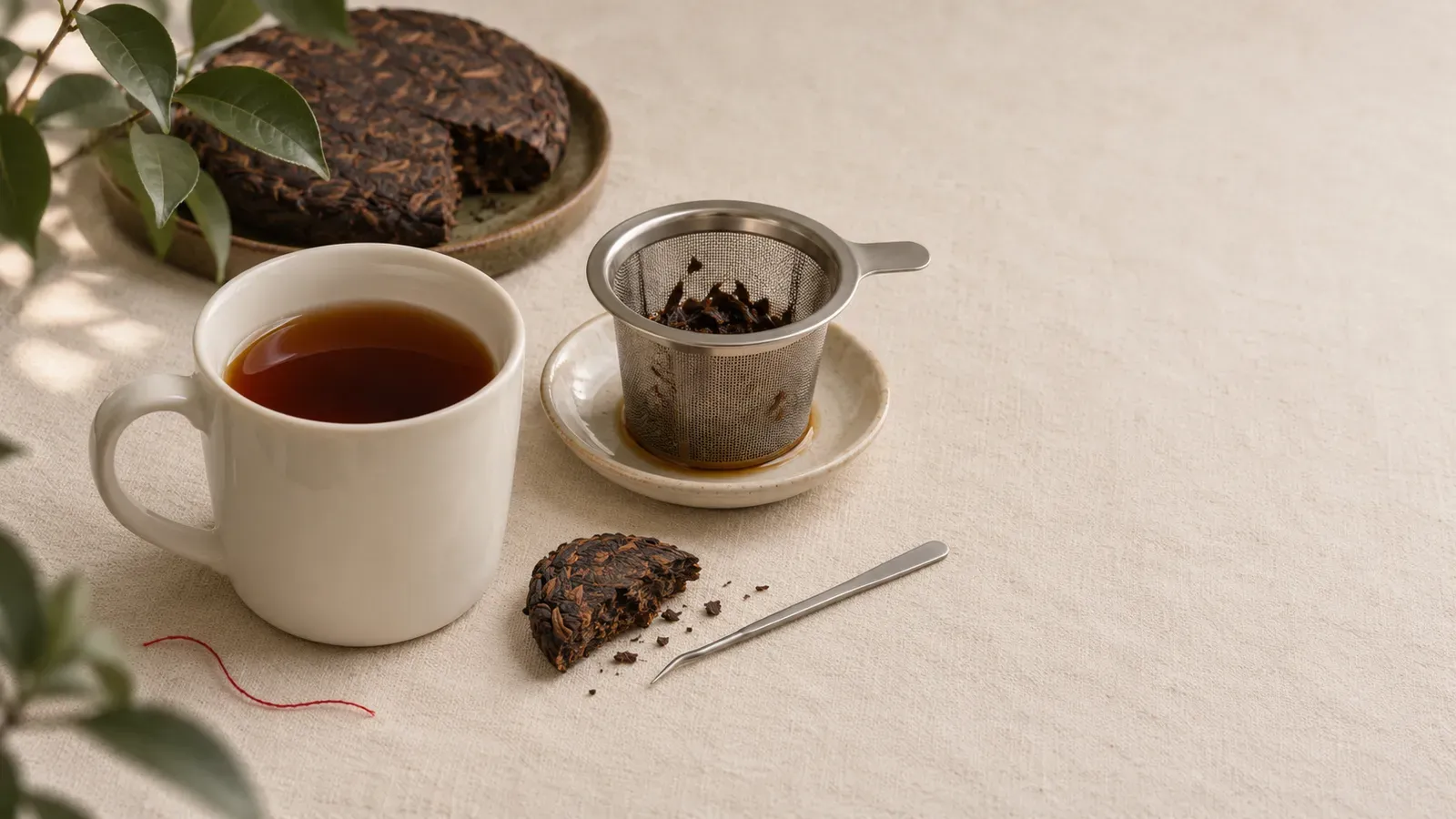
- Something to steep in. A mug with an infuser basket, a teapot with a strainer, or a tall heatproof glass.
- A kettle. Pu'er needs properly hot water, so water from a hot tap or an office dispenser usually makes a flat cup.
- A kitchen scale, if you have one. Compressed tea is hard to judge by eye. Three grams is a piece roughly the size of a large coin.
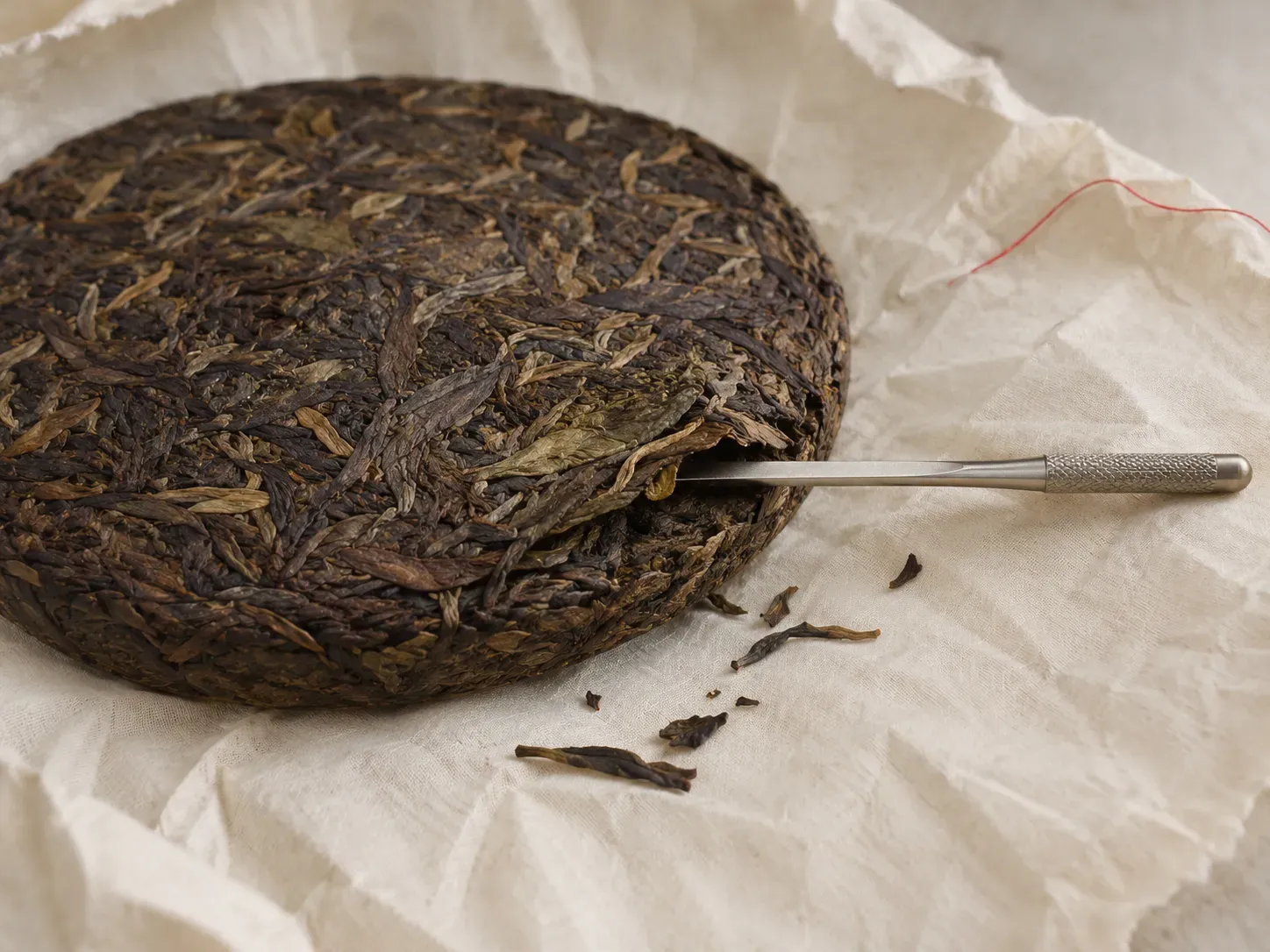
How do you break a piece off a pu'er cake?
Slide a tea pick or a blunt knife into the side of the cake, not the face, and lever upward. The cake is made of pressed layers, and working from the edge lifts off a layer of whole leaves. Stabbing at the face breaks the leaves into dust, which makes the tea brew stronger and more bitter. Keep your other hand behind the pick, not in front of it.
Why rinse pu'er before the first cup?
Pour boiling water over the leaves, wait five to ten seconds, and pour it away. The rinse wakes up tightly compressed leaf so that the first real cup is not thin, and it washes off dust from pressing and storage. It is standard practice for both ripe and raw pu'er.
How much leaf, how hot and how long?
| Method | Leaf | Water | Time |
|---|---|---|---|
| Mug with infuser | 3 g per 300 ml | 100°C / 212°F | 3 minutes, re-steep twice |
| Teapot | 5 g per 400 ml | 100°C / 212°F | 3–4 minutes |
| Tall glass, leaves left in | 2–3 g per 300 ml | 100°C / 212°F | Drink when cool enough, top up when a third is left |
These figures are for ripe pu'er. Raw pu'er needs a different water temperature depending on its age and leaf, and about half the steeping time to start with.
What water temperature for raw pu'er?
| Raw pu'er | Water | Why |
|---|---|---|
| Young (1–3 years) | 90–95°C / 195–205°F | Less bitterness and astringency, keeps the fresh taste |
| Mid-aged (3–10 years) | 95–100°C / 205–212°F | Brings out more aroma and flavour |
| Aged (over 10 years) | 100°C / 212°F | Draws out the aged aroma and a thicker liquor |
| Tender, bud-heavy leaf | 85–90°C / 185–195°F | Keeps the cup from turning strong and bitter |
| Old-tree leaf (mature leaves) | 95–100°C / 205–212°F | Shows the layers in the liquor |
Without a thermometer: water straight off the boil is about 100°C. Leave the kettle open for one to two minutes and it drops to roughly 90–95°C. Start at the lower end of the range, then adjust to taste.
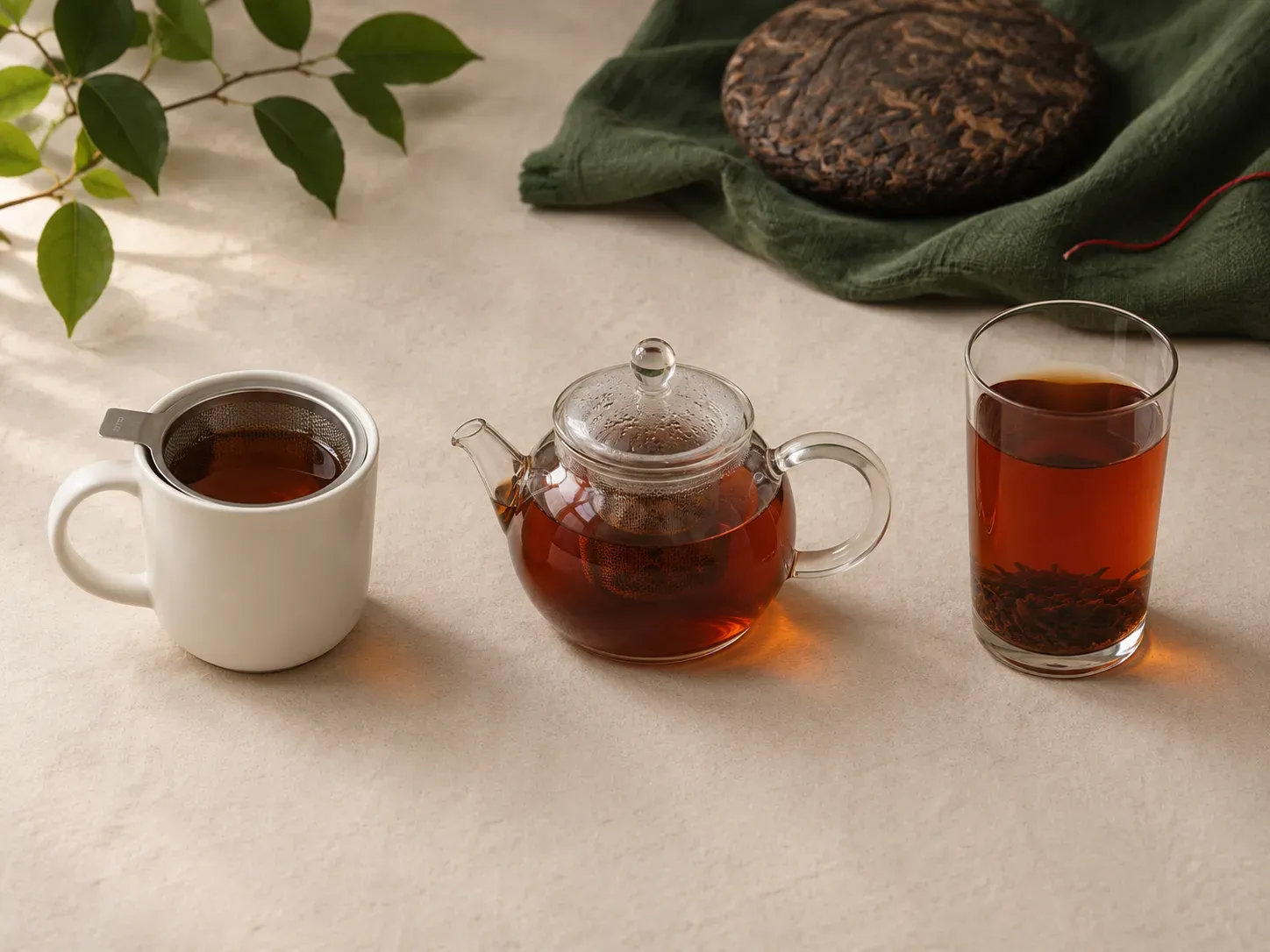
How do you brew pu'er in a mug?
- Put the leaf in the infuser basket and rinse it once.
- Fill the mug with boiling water and steep for about three minutes.
- Lift the basket out and rest it on a saucer. Do not leave the leaves sitting in the cup.
- For the second and third mug, add a minute each time.
How do you brew pu'er in a teapot?
Rinse the leaf in the pot, fill with boiling water and steep for three to four minutes. Pour out all of the tea, into cups or a jug, so that nothing keeps steeping in the pot. The same leaves give two or three more pots.
Can you just leave the leaves in the glass?
Yes. This is how a great deal of tea is drunk in China, sometimes called "grandpa style". Use less leaf than usual, pour on boiling water, and drink once the leaves have sunk. When about a third of the glass is left, top it up with hot water. It works best with ripe pu'er, which stays smooth when it sits. Young raw pu'er left in the glass becomes very bitter.
What if the tea is too strong or too weak?
- Too bitter or harsh: shorten the steep first. If it is still too much, use less leaf or slightly cooler water.
- Too thin: steep longer, or check that your water is really boiling.
- Dusty or muddy taste: rinse a little longer, and break the cake more gently next time so there is less broken leaf.