"Fake" covers several different things in pu'er, and they are not equally easy to check. It helps to separate them.
What does "fake" mean for pu'er?
| Type | What it is | How checkable it is |
|---|---|---|
| Counterfeit brand | A copy of a well-known factory's wrapper on someone else's tea | Sometimes. Collectors compare printing, paper and the small ticket pressed into the cake, but good copies exist |
| False age | A recent cake sold as ten or twenty years old | Partly. Dates, storage history and taste give clues, not proof |
| False origin | Ordinary tea sold as coming from a famous village or mountain | Hardly at all from the outside |
| Not really pu'er | Tea from another region or a different process sold as Yunnan pu'er | Yes, if the seller has to state the origin and the factory |
The middle two are the most common, because they raise the price the most and are the hardest to disprove.
What can the wrapper tell you?
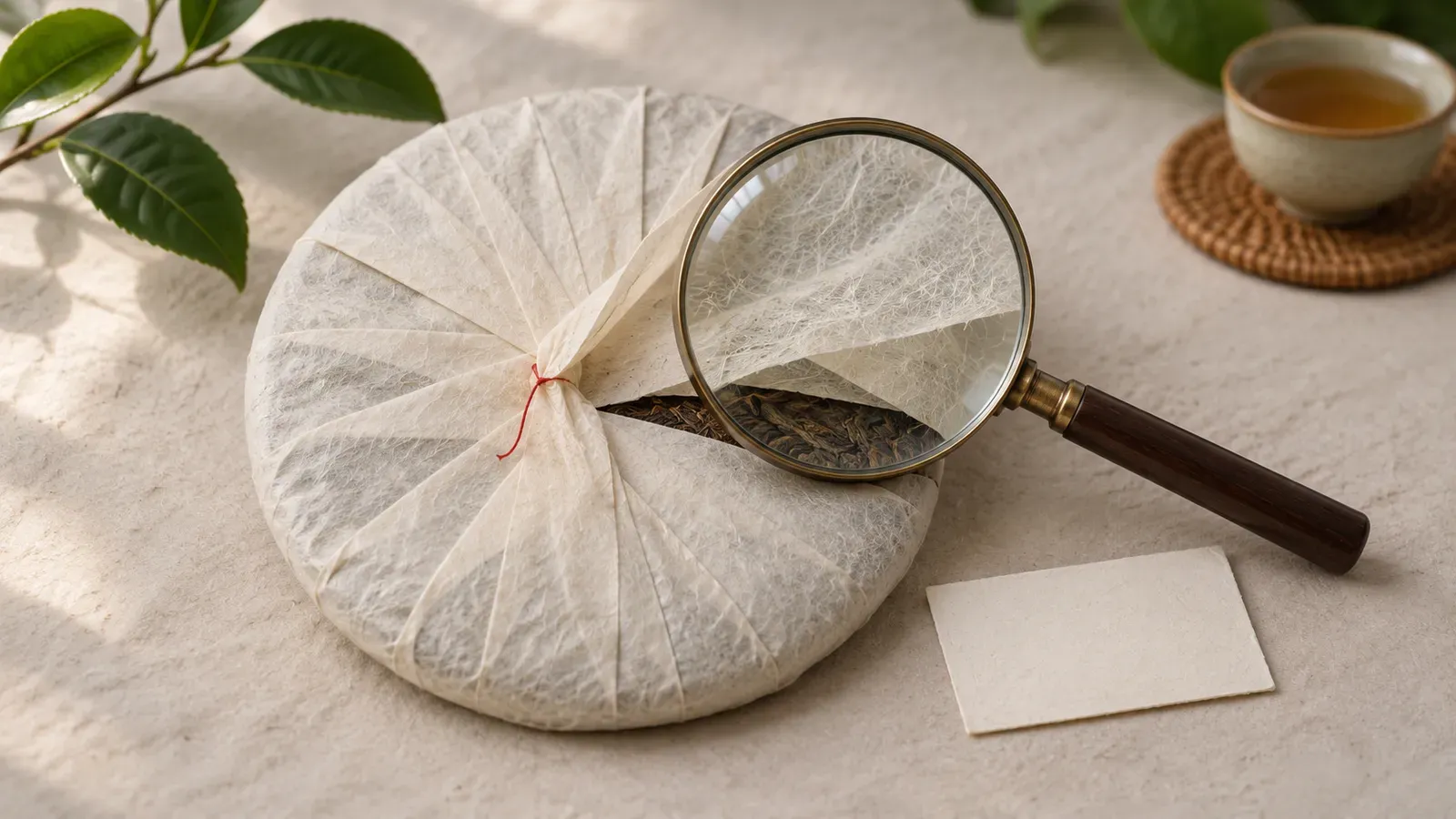
A cake made for sale in China should carry, on the wrapper or on a label:
- the product name and net weight,
- the producer's name and address,
- a production date,
- a food production licence number. On current products it starts with "SC". Older ones carried a "QS" mark.
A cake with none of this is not necessarily bad tea, especially if it is very old or came from a small workshop. But it means you are relying entirely on the seller's word. A wrapper that does carry the information can still be copied, so treat it as a minimum, not as proof.
Note that the production date is normally the date the cake was pressed. The leaf may have been picked earlier. An honest listing tells you both when they differ.
How can you sense-check an age claim?
- Ask where it has been stored. Age is only worth paying for if the storage was clean. A seller who claims fifteen years should be able to say where the tea spent them.
- Look at the price. Genuinely old, well-stored pu'er from a known factory is expensive. A "twenty-year-old" cake at the price of a new one is almost certainly not what it says.
- Be wary of age by smell alone. Tea kept very damp for a short time can look dark and smell old. Strong musty, cellar-like notes point to damp storage, not to age.
- Ripe pu'er is dark from day one. A dark, earthy cake is not evidence of age. Ripe pu'er looks and tastes like that as soon as it is made.
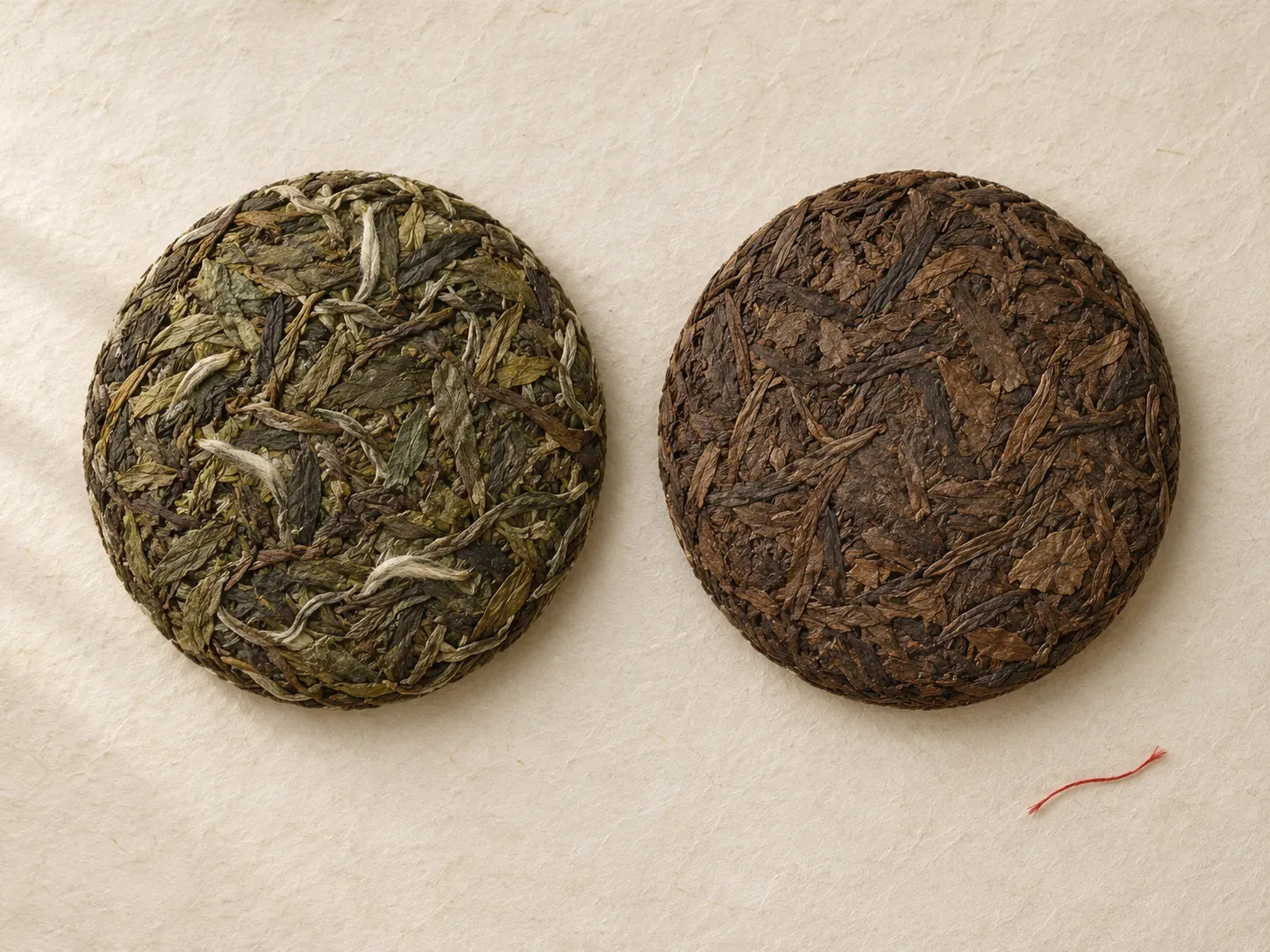 Colour alone does not tell you the age: the dark cake could be old raw pu'er or new ripe pu'er.
How can you sense-check an origin claim?
The best-known villages produce small amounts of tea, and far more tea is sold under their names than they could grow. You cannot verify a village from a photo of a cake. What you can do:
- Prefer sellers who state origin at the level they can support, such as a county or a mountain, over sellers who put the most famous name on everything.
- Compare the price with the claim. Leaf from the most sought-after villages costs many times more than ordinary plantation tea before it is even pressed.
- Buy a sample. If a tea sold as something exceptional tastes ordinary to you, the name was not worth the premium, whatever the truth.
What should a seller be able to show you?
- A stated origin as specific as they can honestly be.
- The harvest year and the pressing date.
- The producing factory and its licence number.
- Where the tea has been stored since it was pressed.
- A lab report for the batch, if they claim the tea has been tested.
- A sample size, so you can taste before committing to a cake.
A seller who answers these plainly is giving you something you can hold them to. Vague answers, or a story in place of details, are the real warning sign.
Is it worth worrying about?
For everyday drinking, not much. An inexpensive cake from an ordinary factory, honestly described, is rarely worth faking. The risk grows with the price and with the fame of the name on the wrapper. If you are paying extra for age, a mountain or a brand, that extra is exactly the part to ask for evidence of.