 Chama Cellar
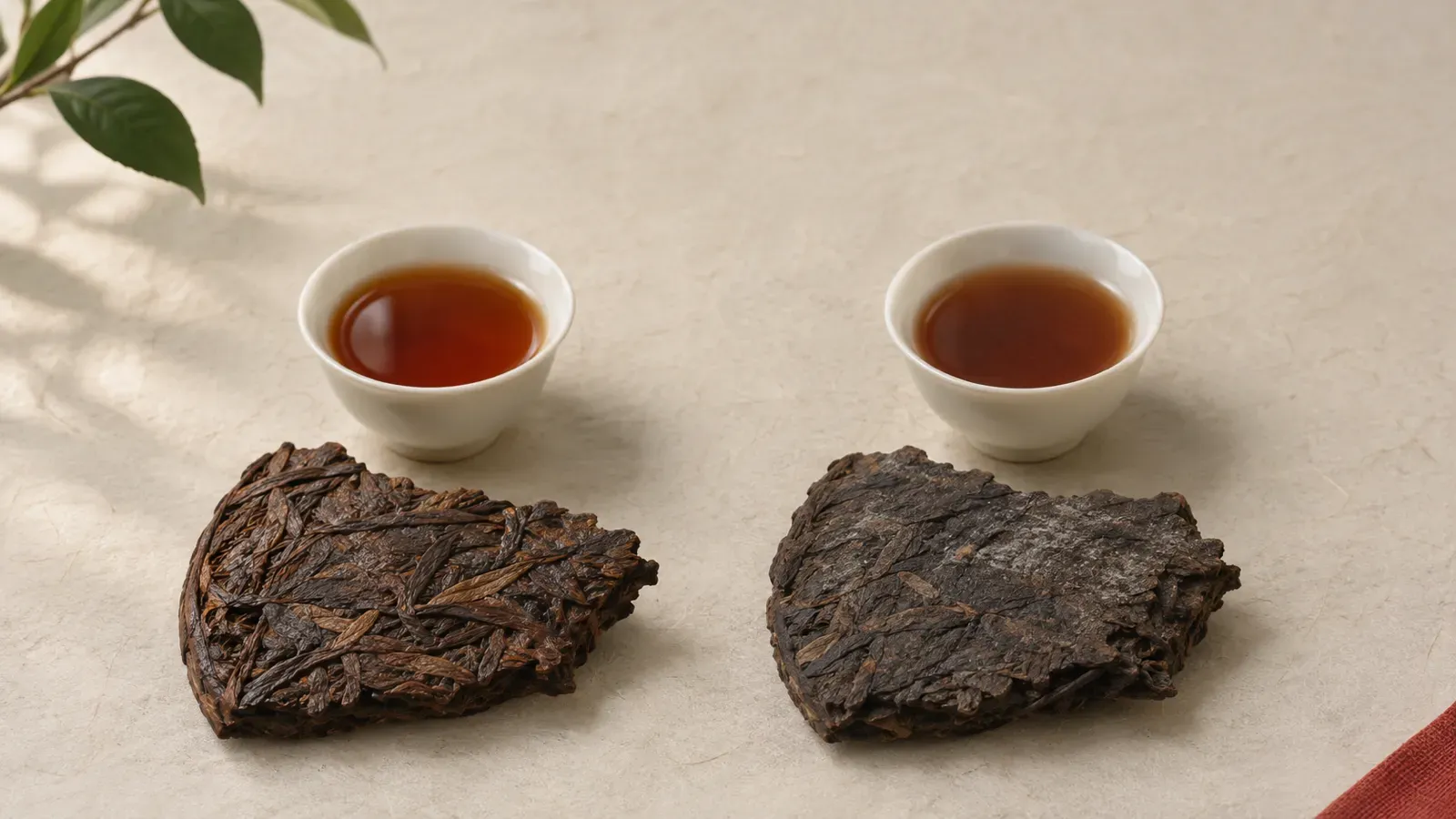
The same raw pu'er cake can taste like two different teas after fifteen years, depending on where it was kept. "Dry" and "wet" are the two words the trade uses for this, and both are used loosely.
What do dry and wet storage mean?
Dry storage (干仓) means the tea was kept in a clean, ventilated space at whatever humidity the local climate provides, with nothing done to raise it. The tea ages at its natural pace.
Wet storage (湿仓) means the tea spent time in a warehouse that was deliberately humid: a ground floor or basement, closed up, sometimes with water added to the air. The best-known version is Hong Kong traditional storage. Merchants there supplied tea houses that wanted dark, mellow tea, and young raw pu'er was too sharp. A few years in a humid warehouse, followed by a period in a drier one to settle, gave them the taste their customers wanted.
Many Hong Kong merchants dislike the word "wet" and say "traditional storage", because a skilled warehouse is controlled, not simply damp. The term "dry storage" only became common later, as a way to mark tea that had not been through that process.
Most of this applies to raw pu'er. Ripe pu'er has already been fermented in the factory, so storage changes it less, though it too can pick up a storage smell in a humid warehouse.
How do the two compare?
| Dry storage | Wet or traditional storage | |
|---|---|---|
| Conditions | Natural air, some ventilation, no added moisture | Warm, closed, humid warehouse, often followed by a drier resting stage |
| Speed | Slow. Raw pu'er can take ten to twenty years or more to turn dark and mellow | Fast. A few years can produce a dark, smooth tea |
| Dry leaf | Brown with some gloss, tips still visible, clean scent | Dark and dull, sometimes with a pale frosty surface |
| Liquor | Orange to clear red-brown, bright | Dark red-brown early on, sometimes cloudy if storage was heavy |
| Taste | Aroma, bitterness and astringency last longer. More lively | Smooth, thick, earthy and woody. Less aroma |
| Risk | Very dry air can stall ageing | Mould and a storage smell that will not leave |
Figures for humidity vary between sources. As a rough guide, dry storage is usually described as staying below about 70 to 80 percent relative humidity, and wet storage as held above that for long periods.
How does the place of storage change the tea?
Even without any deliberate humidity, climate matters. That is why sellers name the city.
- Kunming is high, cool and fairly dry. Tea kept there changes slowly and holds its fragrance. Critics say it can stay sharp for a long time.
- Guangdong, including Guangzhou and Dongguan, is warm and humid. Natural storage there ages tea clearly faster than in Kunming and gives a darker, rounder cup.
- Hong Kong has a similar climate and is the home of traditional storage. Dry-stored tea from Hong Kong also exists.
- Malaysia is hot and humid all year. Tea aged there naturally is often described as changing quickly while staying clean.
So "dry storage" in Guangdong and "dry storage" in Kunming do not produce the same tea. The honest description is the place and the method together.
What is storage smell, and does it air out?
Storage smell, cang wei (仓味), is the scent tea picks up from a humid warehouse: damp earth, old books, a cellar, wet wood. A light version is part of the traditional style and some drinkers seek it out.
It usually fades. Leave the cake in its wrapper in a clean, dry, odour-free place for some months, and break it up into an unglazed jar a few weeks before drinking. A longer rinse, or two, helps as well. What remains after that is part of the tea. A smell from light storage often goes almost completely. A heavy one may soften but not disappear.
How can you tell from the leaf and liquor?
- Dry leaf. Dry-stored tea keeps some sheen, and the leaves separate cleanly. Heavily wet-stored tea looks matt and dark, and may have a greyish bloom.
- Smell of the rinsed leaf. This is the clearest test. Warm, wet leaf shows a storage smell at once.
- Liquor. A very dark liquor from a raw cake that is said to be only a few years old points to humid storage.
- Brewed leaf. Open a leaf after brewing. Dry-stored leaf stays supple and springs back when pressed. Leaf from heavy wet storage can be dark, stiff and brittle, and in the worst cases blackened and hard.
What is the difference between heavy wet storage and mould damage?
Traditional storage that was done well is a style. The tea is dark and earthy, and it brews clear. Heavy wet storage pushes further: the leaf is dull, the liquor murky, the taste flat.
Mould damage is a fault. Signs are fuzzy white, yellow or green growth on the surface or between the leaves, a sharp musty smell that does not fade with airing, and a liquor that stays cloudy. Tea in that state should not be drunk.
A thin, even, pale frost on old traditionally stored tea is often accepted in the trade, and it is hard to judge. If you are not sure what you are looking at, treat it as a fault.
What should a seller disclose?
- Where the tea was stored, by city or region, and for roughly how long in each place.
- What kind of storage: natural, or a humid warehouse at any stage.
- Any storage smell, described plainly.
- Photographs of the actual dry leaf, the liquor and the brewed leaf.
- A sample, because storage is far easier to taste than to describe.
"Dry stored" with no place named tells you very little.