 Chama Cellar
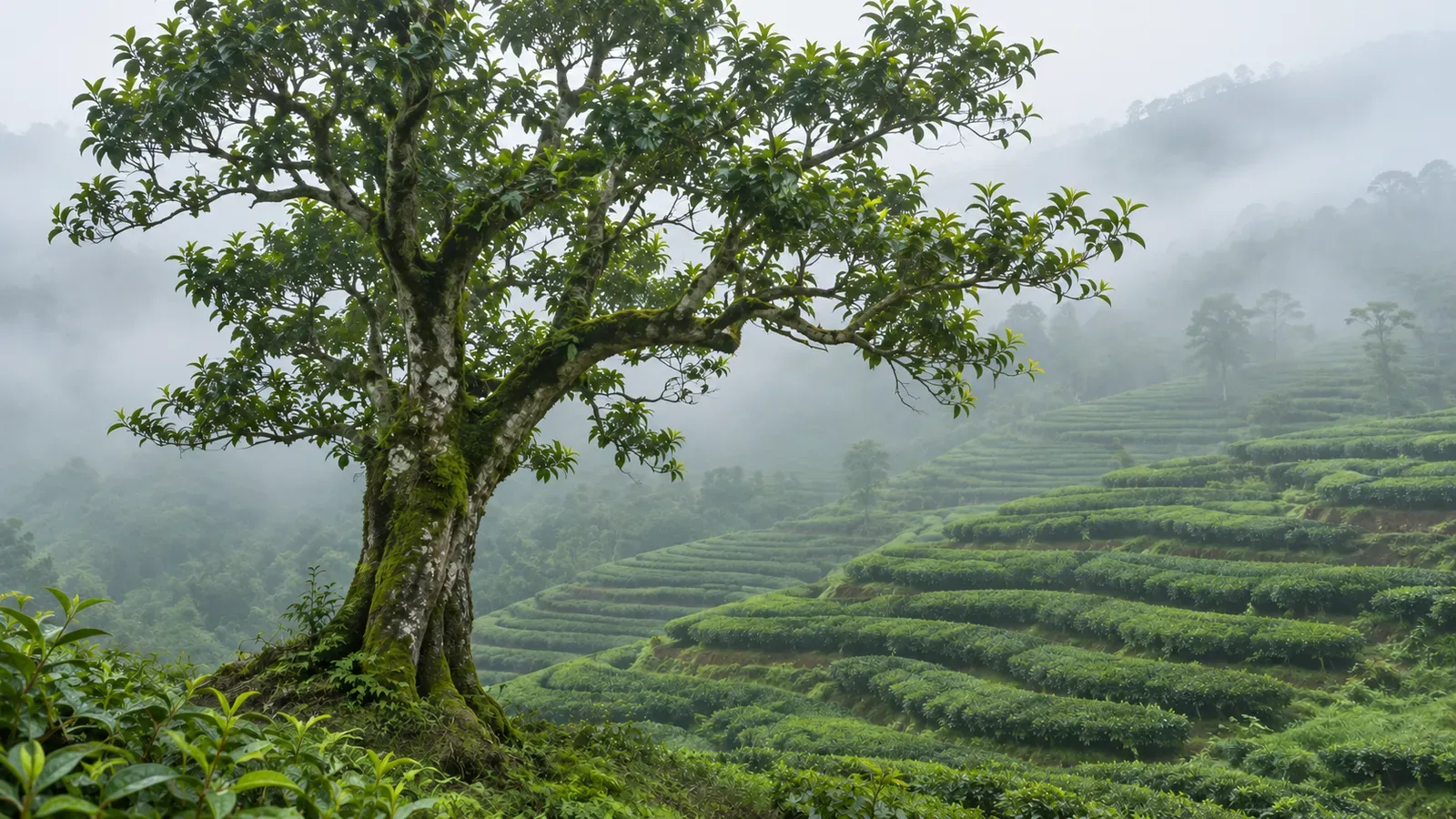
Gushu and taidi describe the plants the leaf came from, not how the tea was made. Either can become raw or ripe pu'er. The words matter because they move the price more than almost anything else on a wrapper, and because one of them is used far more often than it is true.
What do gushu, qiaomu and taidi mean?
| Term | Chinese | What it usually means |
|---|---|---|
| Gushu | 古树 | "Ancient tree". Leaf from old tea trees, by common convention over about 100 years old |
| Dashu, laoshu | 大树, 老树 | "Big tree", "old tree". Looser words, usually for trees younger than gushu. No agreed age |
| Qiaomu | 乔木 | "Arbor". A tea plant left to grow as a tree with a trunk. It describes the form, not the age |
| Xiaoshu | 小树 | "Small tree". Young trees, often seed-grown and planted in the old spaced-out way |
| Taidi | 台地 | "Terrace". Closely planted, pruned bushes in modern plantations |
Two points cause most of the confusion.
First, the 100-year line is a convention, not a measurement. Yunnan's regulation on protecting ancient tea trees uses the same figure for cultivated trees, but that regulation is about protecting the trees. It does not police what a tea company prints on a wrapper. Some people in the trade set their own bar higher, at 200 or 300 years. Tree ages are mostly estimated from trunk size and village memory, and published figures for famous trees are often disputed.
Second, qiaomu is not a synonym for gushu. A tree planted twenty years ago and left unpruned is qiaomu. The word on a wrapper tells you very little.
How are the two grown?
Old-tree gardens. The trees were grown from seed, often generations ago, and stand well apart, frequently among other forest trees. Each one is genetically a little different from its neighbours. They are picked by hand, sometimes by climbing, and each tree gives a small amount of leaf. Many gardens are picked only in spring and autumn.
Terrace plantations. Most were laid out in the second half of the twentieth century and later, as rows of bushes on terraced slopes. The plants are kept at about waist height for easy picking, set close together, and are often grown from cuttings of selected cultivars, so a whole slope can be nearly identical. They are usually fertilised and managed for yield, and can be picked many times a year.
There is plenty in between: seed-grown plantations from the mid-century, terraces that were abandoned and left to grow wild, and young trees planted in the old manner. Sellers use words such as "ecological tea" (生态茶) for some of these. None of them has a fixed meaning.
How do they tend to differ in the cup?
These are tendencies that experienced drinkers commonly report, not guarantees.
| Gushu | Taidi | |
|---|---|---|
| Body | Thicker, more oily in the mouth | Lighter, thinner |
| Bitterness and astringency | Present but usually fades quickly | Often sharper and slower to clear |
| Aroma | Quieter, held in the liquid | Often brighter and more upfront |
| Aftertaste | Longer, with a lasting sweetness in the throat | Shorter |
| Infusions | Often keeps going for more pours | Tends to thin out sooner |
Processing, season and storage can outweigh the tree. A carefully made spring plantation tea can be better to drink than a clumsily made old-tree tea, and plenty of experienced drinkers cannot reliably tell the two apart blind. Most of the pu'er ever made, including well-regarded factory recipes, is plantation or blended leaf.
The difference is mostly discussed for raw pu'er. Wet-piling changes the leaf so much that the origin of the material is harder to taste in ripe pu'er.
Why is gushu so often mislabelled?
- The supply is small. Old trees are a minor share of Yunnan's tea area and each tree yields little. Far more tea is sold as gushu than the trees could produce.
- The price gap is large. Fresh leaf from old trees sells for many times the price of plantation leaf, and more in famous villages. The word alone adds value.
- Nobody enforces the word. No labelling standard that is checked in the market defines "ancient tree" on a wrapper. A producer can print it without proving anything.
- Blending is easy to hide. A share of old-tree leaf mixed with plantation leaf from the same slope still gets called gushu. Once the leaf is pressed into a cake, the mix cannot be seen.
- Buyers are far away. Almost no one who buys a cake has seen the garden.
What can a buyer verify, and what not?
You cannot verify:
- The age of the trees. No routine test tells tree age from finished tea.
- The share of old-tree leaf in a cake.
- Anything from leaf appearance alone. Thick stems, large leaves or uneven leaf size are often quoted as signs of old trees. They vary with cultivar, season and picking standard, and are not dependable.
You can check:
- Whether the claim is specific. A named village or mountain, a harvest season and year, and a producer are things a seller can be held to. "Thousand-year ancient tree" with nothing else is not.
- Whether the price fits. Gushu priced like everyday plantation tea is not gushu.
- Whether the seller admits blends. A listing that says "mixed old-tree and plantation leaf" is more believable than one that calls everything pure gushu.
- How it tastes to you. Buy a sample and brew it beside an honest plantation tea from the same area. If you cannot taste a difference worth the extra money, do not pay it.
Which should you buy?
For everyday drinking, a well-made plantation tea that is described honestly is a good choice and nothing to apologise for. If you want to find out what old-tree tea is about, buy a small sample from a seller who gives details, and compare. Treat "gushu" on a wrapper as a claim to be tested, not as a grade.