 Chama Cellar
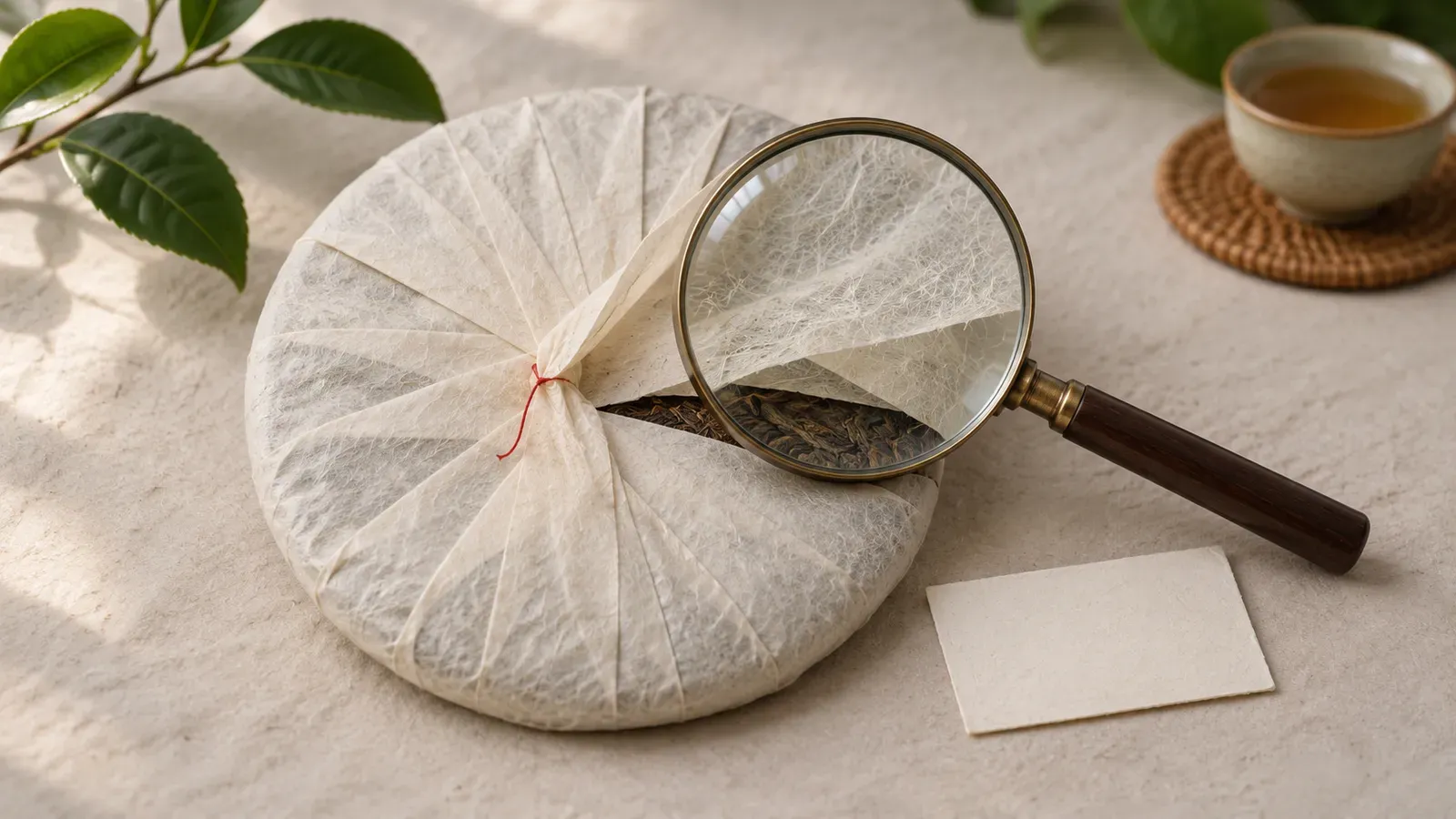
A pu'er cake comes folded in a sheet of thin paper. The front carries the brand and the name of the tea. The required details are usually on the folded back or on a sticker, mostly in Chinese only.
What is printed on the front?
- The brand or factory. A logo and a name. One classic design, a ring of eight 中 characters around a 茶 character, was used on state-factory cakes for decades and has been copied ever since. On its own it tells you little.
- The product name. This can be a recipe number, a mountain or village, or simply a name the producer made up.
- The type. 生茶 is raw pu'er and 熟茶 is ripe pu'er. It is not always on the front, so check the back.
- 云南七子饼茶. "Yunnan seven-sons cake tea" is the traditional name for cakes packed seven to a stack. It is a format, not a brand.
Which Chinese terms are worth knowing?
| Chinese | Pinyin | Meaning |
|---|---|---|
| 生茶 / 熟茶 | shēng chá / shú chá | Raw / ripe pu'er |
| 净含量 | jìng hán liàng | Net weight |
| 生产日期 | shēng chǎn rì qī | Production date |
| 生产商 | shēng chǎn shāng | Producer (the factory that made it) |
| 产地 | chǎn dì | Place of origin |
| 保质期 | bǎo zhì qī | Shelf life, often given as "long term under suitable storage" |
| 生产许可证编号 | shēng chǎn xǔ kě zhèng biān hào | Production licence number |
| 产品标准号 | chǎn pǐn biāo zhǔn hào | Product standard, often GB/T 22111 for pu'er |
| 批次 | pī cì | Batch |
What does the net weight tell you?
The most common cake is 357 g. The usual explanation is that seven of them make about 2.5 kg, a convenient unit for trade. Smaller cakes of 100 g or 200 g, 250 g bricks and larger 400 g or 500 g cakes are also normal.
The printed weight is the weight at pressing. A cake can lose a little as it dries over the years, so an old cake that weighs a few grams under is not unusual.
Is the production date the harvest year?
No. The production date is normally the day the cake was pressed or packed. The leaf may have been picked that same spring, or it may have been kept loose for a year or more first. Ripe pu'er is fermented before pressing, and blends can combine leaf from several years.
Many older cakes carry no printed date at all. Dates on those are stamped later or simply stated by the seller.
What do four-digit recipe numbers like 7542 mean?
Recipe numbers (唛号, mài hào) come from the large, formerly state-owned factories. Take 7542:
- 75: the year the recipe is said to have been created, here 1975. It is not the year the cake was made.
- 4: the grade of leaf the blend is built around. Lower numbers mean smaller, more tender leaf.
- 2: the factory.
| Last digit | Factory |
|---|---|
| 1 | Kunming Tea Factory |
| 2 | Menghai Tea Factory |
| 3 | Xiaguan Tea Factory |
| 4 | Most often given as Pu'er Tea Factory, though sources do not all agree |
So 7542 and 7572 are Menghai recipes, the first a raw cake and the second a ripe one. 8653 is a Xiaguan raw cake, and 7581 is a ripe brick associated with Kunming.
Three cautions. A 7542 is pressed again every year, so the number says nothing about age. The grade digit is nominal, because real blends mix several grades. And other producers now print these numbers on their own cakes as a style reference, so the last digit does not prove who made the tea. Most small producers do not use recipe numbers at all.
What is a batch number?
A large factory presses the same recipe several times a year. On Menghai's Dayi cakes the batch is commonly three digits, such as 701, read as the first batch of 2007. Later cakes use four, such as 1401 for the first batch of 2014. Other factories differ, and many cakes have no batch number.
What is the SC code?
Modern packaged food made in China carries a production licence number: the letters SC followed by 14 digits. The first three digits are the food category, and tea producers' numbers normally begin with 114. The next two are the province, with 53 for Yunnan.
The SC number came in with licensing rules that took effect in October 2015. It replaced the older QS mark, which could no longer be printed on food produced from October 2018.
This gives a rough cross-check. An SC number on a wrapper dated 2010 does not fit, although old cakes are sometimes rewrapped. The licence also belongs to the factory that pressed the cake, which is often not the brand on the front.
What are the nei fei and the nei piao?
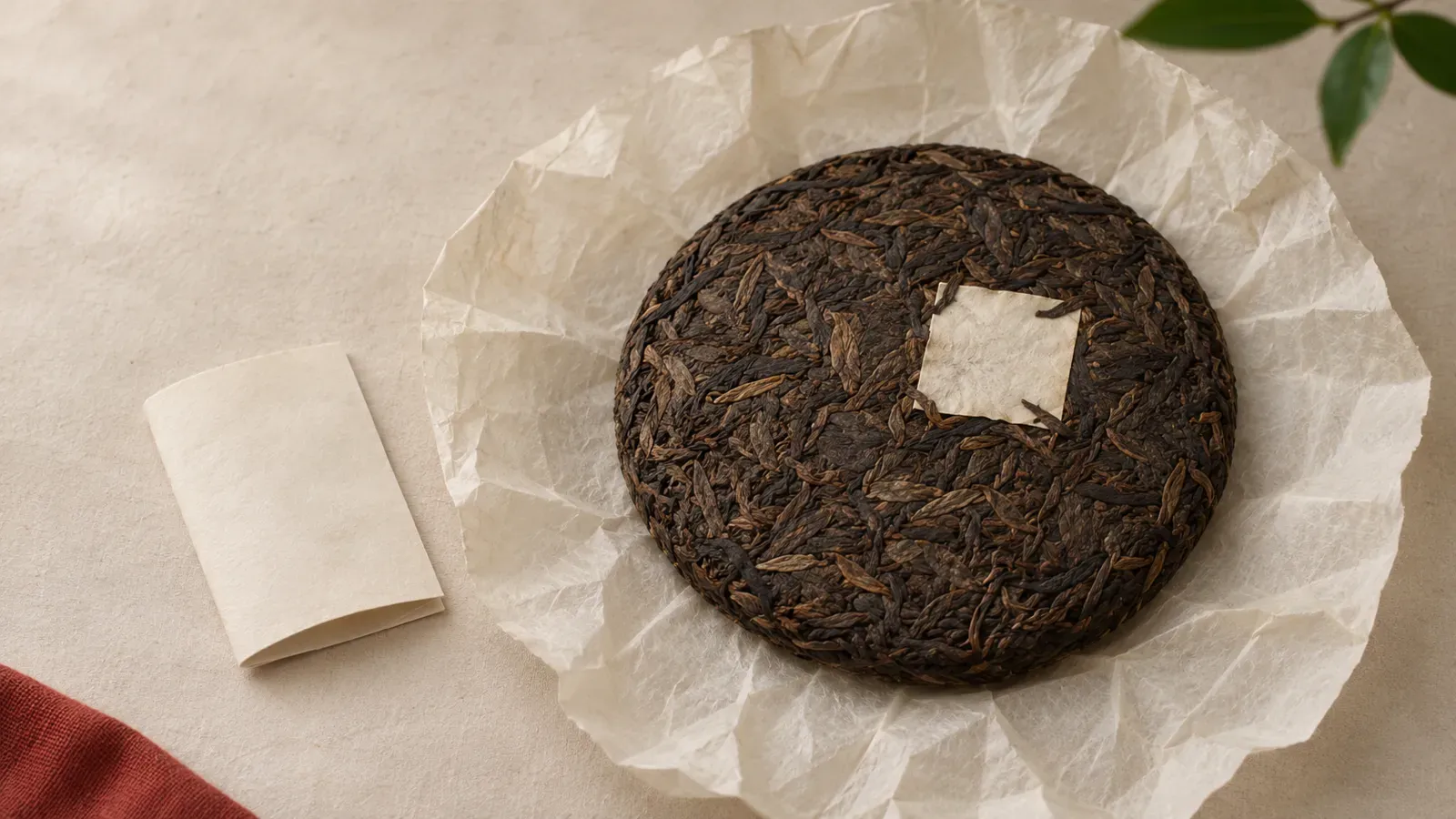
- Nei fei (内飞). A small paper ticket pressed into the face of the cake, partly under the leaf. It usually carries the brand mark. It cannot be swapped without damaging the cake.
- Nei piao (内票). A larger loose slip between the cake and the wrapper, with a description of the tea or the producer. It can be lost or replaced easily.
Not every cake has both. Some brands also put a security sticker over the back fold.
What can the wrapper not tell you?
- Whether the name is true. Nobody checks a village or mountain name before it is printed.
- How the tea was stored. The wrapper records the pressing, not the years that followed.
- How it tastes. Tidy labelling and good tea are separate things.
- Whether the paper belongs to the cake. Wrappers can be reprinted and cakes rewrapped.
- What 古树 or 纯料 mean here. "Old tree" and "single-origin" are the producer's own descriptions. Nothing on the wrapper lets you check them.