 Chama Cellar
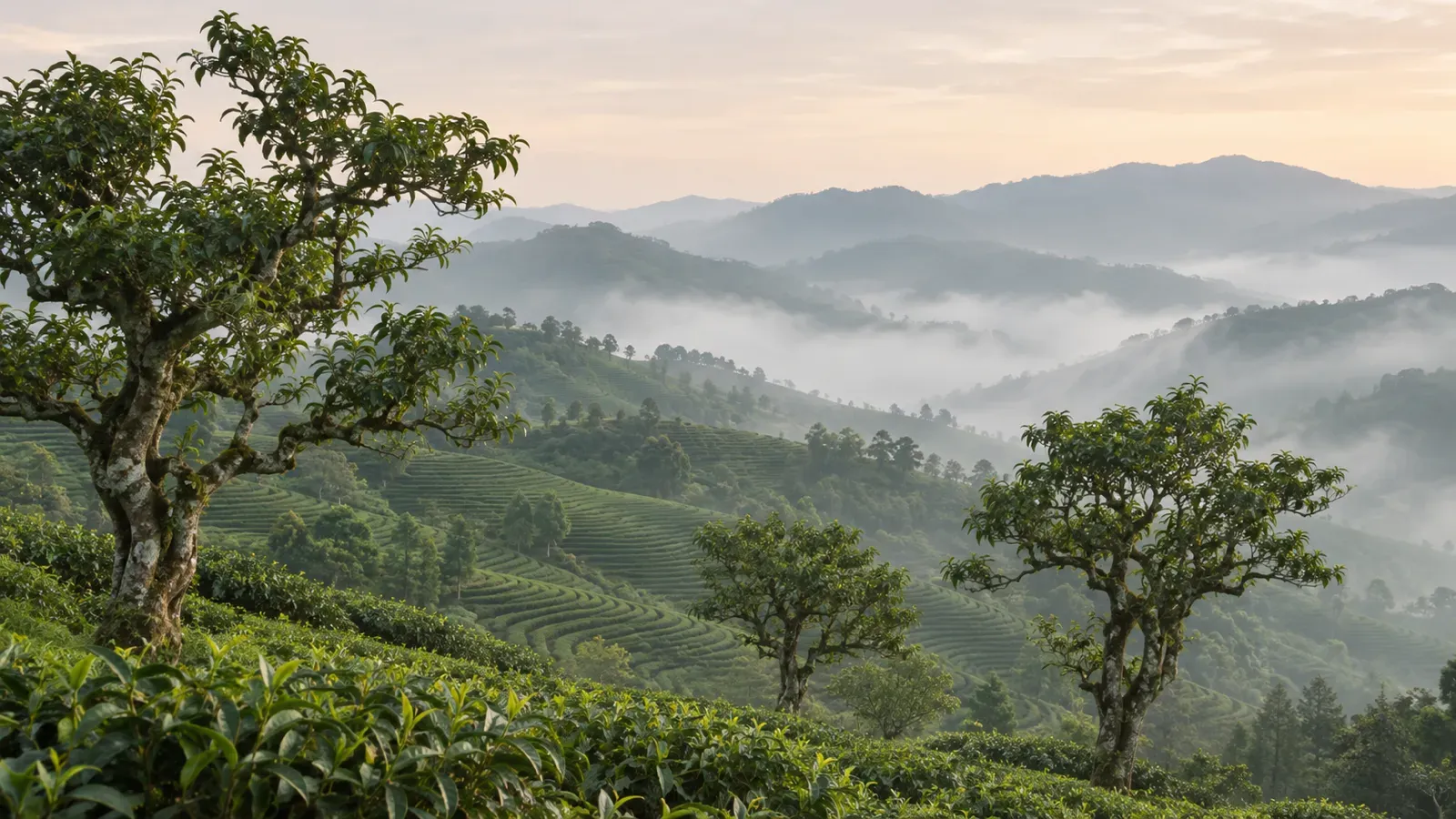
Pu'er is tied to place more closely than most teas. The name is protected by geography, and much of the price of a cake depends on the mountain printed on its wrapper.
Which parts of Yunnan produce pu'er?
The tea country lies in the south-west of the province, in the hills on both sides of the Lancang River, which becomes the Mekong downstream. Three prefectures account for most of the well-known tea: Xishuangbanna in the far south, Pu'er city to its north, and Lincang further north again. Baoshan, in the west, is a smaller fourth.
| Prefecture | Well-known counties and areas | Character usually associated with it |
|---|---|---|
| Xishuangbanna | Menghai county, with Bulang Mountain, Lao Banzhang and Nannuo. Mengla county, with Yiwu and most of the old "six tea mountains". Jinghong, with Youle | Menghai: strong, thick, with marked bitterness that turns sweet. Yiwu: softer, sweet and fragrant |
| Pu'er city | Jingmai Mountain in Lancang county, Jinggu, Zhenyuan, Ning'er | Often described as gentler and aromatic. Jingmai is known for a floral, orchid-like scent |
| Lincang | Bingdao and the Mengku area in Shuangjiang county, Xigui in Linxiang district, Fengqing | Bright and sweet, with strong aroma. Bingdao is known for a lingering sweetness, Xigui for fragrance |
| Baoshan | Changning, Tengchong | Less often sold under village names. Usually described as clean and fairly brisk |
Treat the right-hand column as a rough guide. Taste varies with the garden, the age of the trees, the season and the way the leaf was processed. Two teas from neighbouring villages can differ more than two teas from different prefectures.
Why is there a city called Pu'er?
The tea takes its name from the old town and prefecture of Pu'er, which was a collecting and trading centre for tea from the surrounding mountains. The modern city was called Simao until 2007, when it was renamed Pu'er. The county that holds the old town of Pu'er is now called Ning'er. So "Pu'er" on a map today means a large prefecture-level city, and tea from Xishuangbanna or Lincang is still pu'er tea.
What does the national standard say?
Pu'er tea is a protected geographical indication in China. The national standard, GB/T 22111-2008, came into force in December 2008. It defines pu'er as tea made from sun-dried leaf of the Yunnan large-leaf tea plant, grown and processed inside the protected area. The area is usually given as 639 townships in 75 counties across 11 prefectures and cities of Yunnan. Besides the four above, the list includes Dehong, Dali, Chuxiong, Honghe, Wenshan, Yuxi and Kunming.
Two things follow. Dark tea made elsewhere by a similar method cannot properly be labelled pu'er in China. And the standard covers both kinds: raw pu'er, and ripe pu'er made by pile fermentation.
What do "ancient tree" and "plantation" mean?
- Ancient tree, gushu (古树). Tea from old trees that grow tall and well apart, often in mixed forest. There is no single rule for trade labelling. One hundred years is the threshold most often used, and Yunnan's rules for protecting old tea trees use that figure for cultivated trees.
- Plantation or terrace tea, taidi (台地茶). Tea from bushes planted close together in rows, usually on terraced slopes, and kept low by pruning. Most of these gardens date from the second half of the twentieth century. They supply most of the pu'er on the market.
- In between. Terms such as "big tree", "small tree" and "arbor" (qiaomu) are used loosely for trees that are neither very old nor pruned bushes.
Old trees give less leaf, and that leaf costs far more. Whether it tastes better is for the drinker to decide. A well-made plantation tea can be a better drink than a carelessly made tea from old trees.
Why are famous village names faked so often?
Because the name carries the price, and the name is nearly impossible to check from the outside.
A village such as Lao Banzhang or Bingdao has a limited number of old trees, and the amount they yield each spring is small. Far more tea is sold under those names than the trees could give. The leaf may come from nearby villages, from the wider mountain, from young bushes planted around the old trees, or from somewhere else entirely.
Nothing on a pressed cake proves which village the leaf came from. A seller who states origin at the level that can be supported, such as the county or the mountain, is telling you more than a seller who prints the most famous name on everything.
Does the region matter for an everyday drinker?
It is useful as a starting point. If you like a strong tea with some bitterness, teas from Menghai are a sensible place to begin. If you prefer something softer and sweeter, look to Yiwu or Lincang. After that, trust what is in the cup over what is on the label.