 Chama Cellar
Pu'er does not have one taste. The same leaf from Yunnan gives very different cups depending on whether it is raw or ripe, how old it is, where it has been kept and how it is brewed.
What does each type of pu'er taste like?
| Young raw pu'er | Aged raw pu'er | Ripe pu'er | |
|---|---|---|---|
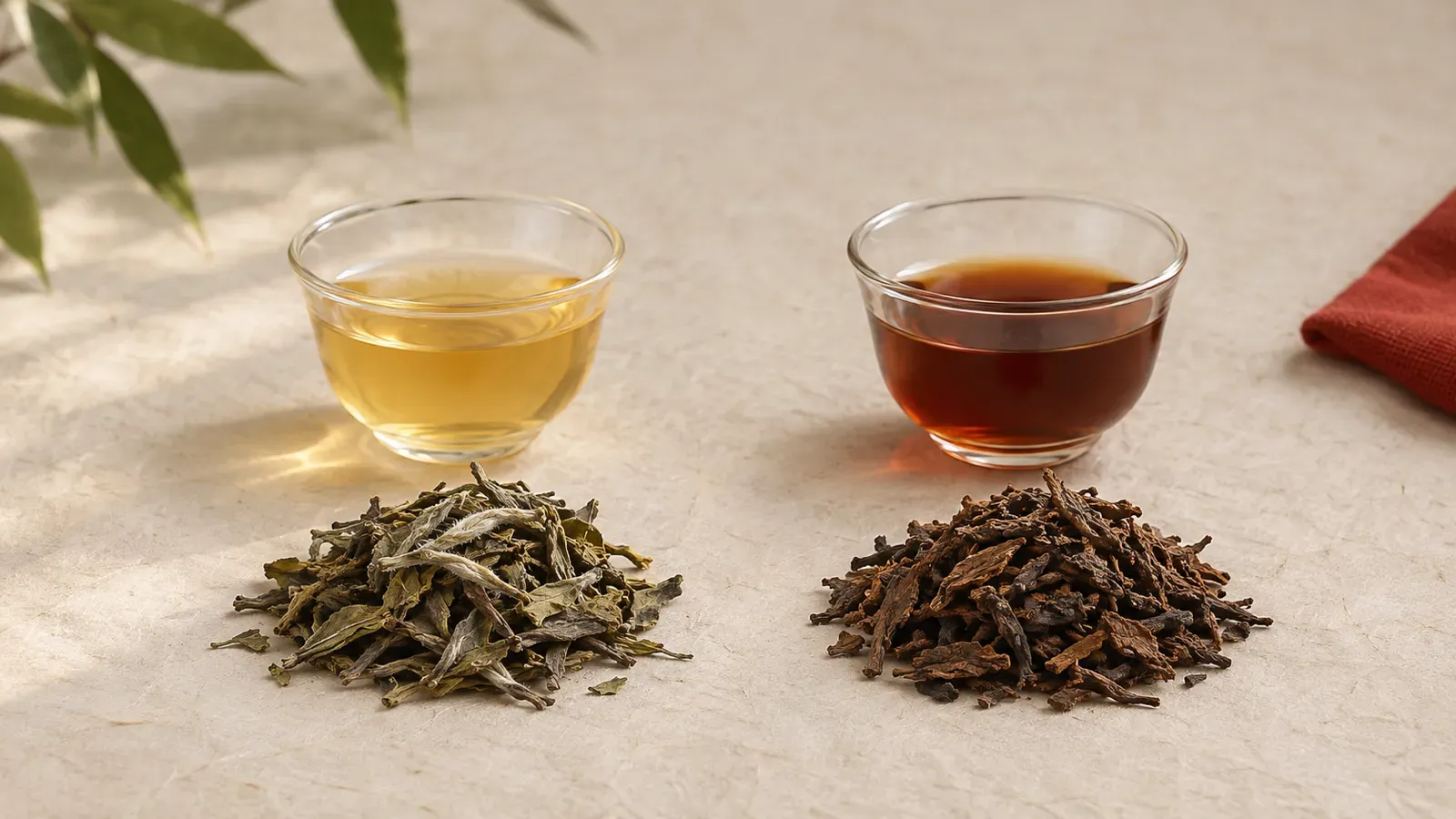
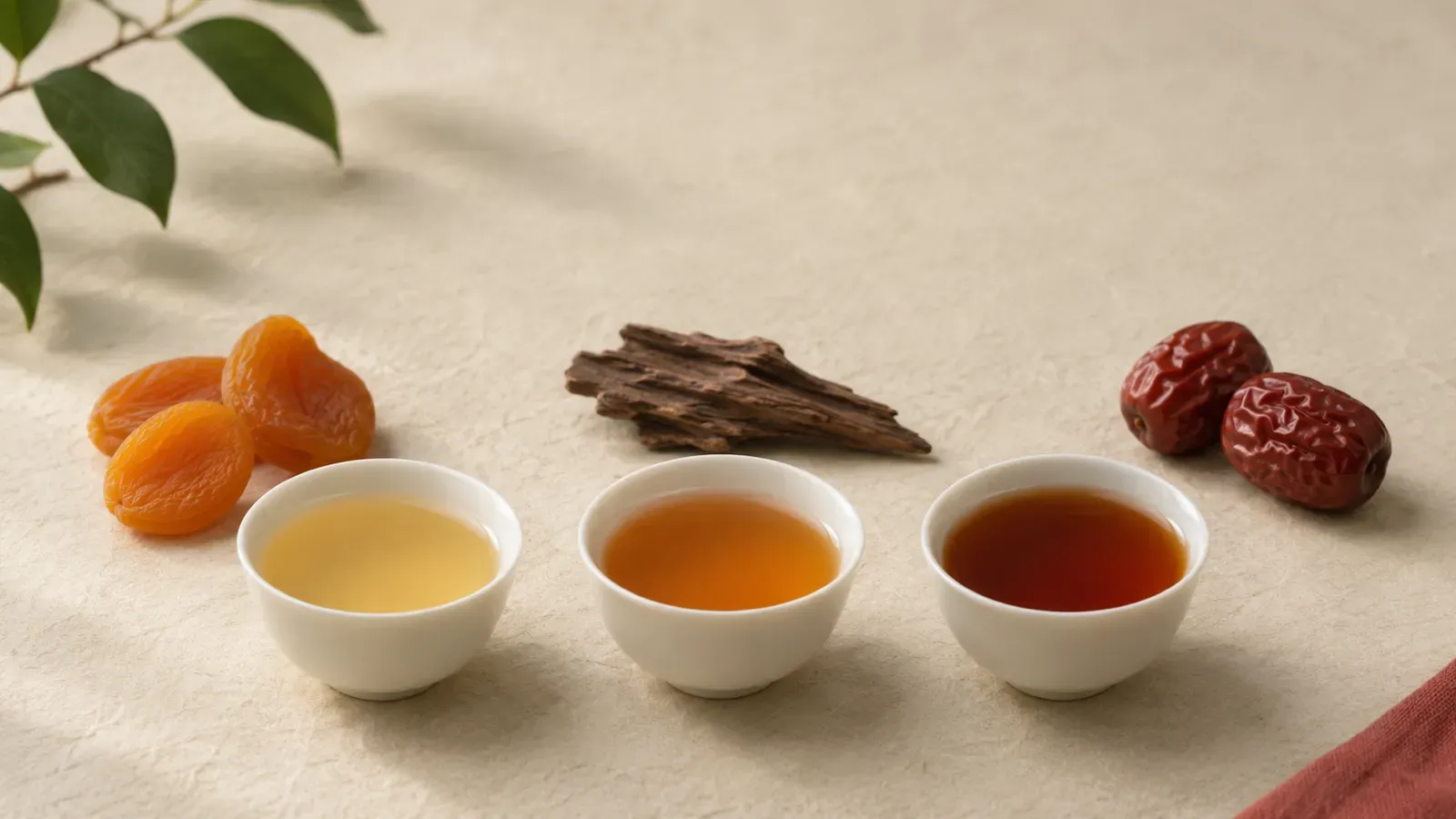
| Colour in the cup | Pale yellow to gold | Orange to red-brown | Deep red-brown |
| Aroma | Flowers, fresh hay, green fruit, sometimes honey | Wood, dried fruit, camphor, old books | Damp earth, wood, dates, cocoa |
| Taste | Bright, bitter-sweet, often astringent | Smooth, mellow, gently sweet | Thick, soft, mildly sweet |
| Bitterness | Clear, sometimes strong | Low | Very low |
| Aftertaste | Sweetness returning in the throat | Long and sweet | Soft, sometimes a little sweet |
These are tendencies, not rules. Tea from different mountains, seasons and makers varies a great deal inside each column.
What does young raw pu'er taste like?
A young raw pu'er, a few years old or less, is the closest to green tea. It smells fresh: flowers, cut grass or hay, apricot or other stone fruit. The first sip is often bitter and drying. Then, after you swallow, a sweetness comes back in the throat. Drinkers look for that change, and it is the main reason people accept the bitterness.
Some raw pu'er also has a smoky note. This is usually put down to how the leaf was fired or dried, and it tends to fade with age.
What does aged raw pu'er taste like?
Over years in storage, raw pu'er darkens and calms down. The sharp green notes go. In their place come wood, dried fruit, honey, and in some teas a cool, camphor-like aroma. The bitterness softens and the liquor feels rounder. How fast this happens depends heavily on storage. Tea kept in a warm, humid climate changes faster than tea kept somewhere cool and dry, and the two end up tasting different.
What does ripe pu'er taste like?
Ripe pu'er is the dark, smooth one. The liquor is thick and red-brown. Common comparisons are forest floor after rain, wet wood, dates, dark bread and unsweetened cocoa. There is little bitterness or astringency, and a gentle sweetness. People who dislike bitter tea often get on well with ripe pu'er. People who expect something light and fragrant are sometimes surprised by how earthy it is.
Why does some ripe pu'er smell earthy or fishy?
Ripe pu'er is fermented in large damp piles for several weeks. The smell left behind by that process is called dui wei (堆味), or wo dui wei, the pile smell. It can come across as damp earth, wet cardboard, or a slightly fishy or pond-like note. It is strongest in tea that was made recently.
It usually fades. Things that help:
- Rest the tea. Leave a new cake in its paper wrapper, in a clean place with no smells, for a few weeks. Tea that was shipped sealed benefits the most.
- Break it up ahead of time. Pry off what you will drink over the next few weeks and keep it in an unglazed jar or a paper bag, so that air reaches the leaf.
- Rinse. Pour boiling water over the leaf and discard it after a few seconds, once or twice, before the first cup.
A pile smell that is still heavy after a year or two is more likely to be a sign of how the tea was fermented than something that more time will solve.
Pile smell is not the same as mould. A clearly musty smell, like a damp cellar, together with fuzzy white, yellow or green patches on the leaf, means the tea has been stored badly. Do not drink it.
Why is my pu'er bitter, and can brewing change that?
Bitterness (ku, 苦) and astringency (se, 涩), the dry, puckering feeling on the tongue, are natural in young raw pu'er. The useful question is whether they pass. In a good tea they fade quickly and leave sweetness behind. In a poor one they sit on the tongue.
Brewing changes how much of them you get:
| Change | Effect |
|---|---|
| Shorter steep | Less bitterness and astringency. Try this first |
| Slightly cooler water, around 90–95°C / 195–205°F | Softer cup from young raw tea |
| Less leaf | Lighter overall |
| Whole pieces instead of broken leaf and dust | Slower, gentler extraction |
| Pouring all the tea off the leaves | Stops the next cup from over-steeping |
Ripe pu'er rarely turns bitter. If a ripe tea tastes flat, the usual fix is the opposite: hotter water and a longer steep.
What do the common tasting words mean?
| Term | Meaning |
|---|---|
| Hui gan (回甘) | "Returning sweetness". The sweet feeling in the throat after a bitter sip |
| Sheng jin (生津) | A mouth-watering feeling at the sides of the tongue and cheeks |
| Ku (苦) and se (涩) | Bitterness and astringency |
| Hou yun (喉韵) | "Throat feel". A pleasant sensation that lingers in the throat after swallowing |
| Chen xiang (陈香) | Aged aroma. The woody, mellow smell of well-stored older tea |
| Zhang xiang (樟香) | A camphor-like note found in some aged tea |
| Zao xiang (枣香) | A date-like sweetness, common in ripe pu'er |
| Dui wei (堆味) | Pile smell left over from wet-piling |
| Hua (滑) and hou (厚) | Smooth and thick. Words for how the liquor feels in the mouth |
You do not need these words to enjoy the tea. They are useful mainly for reading descriptions and comparing notes with other drinkers.