 Chama Cellar
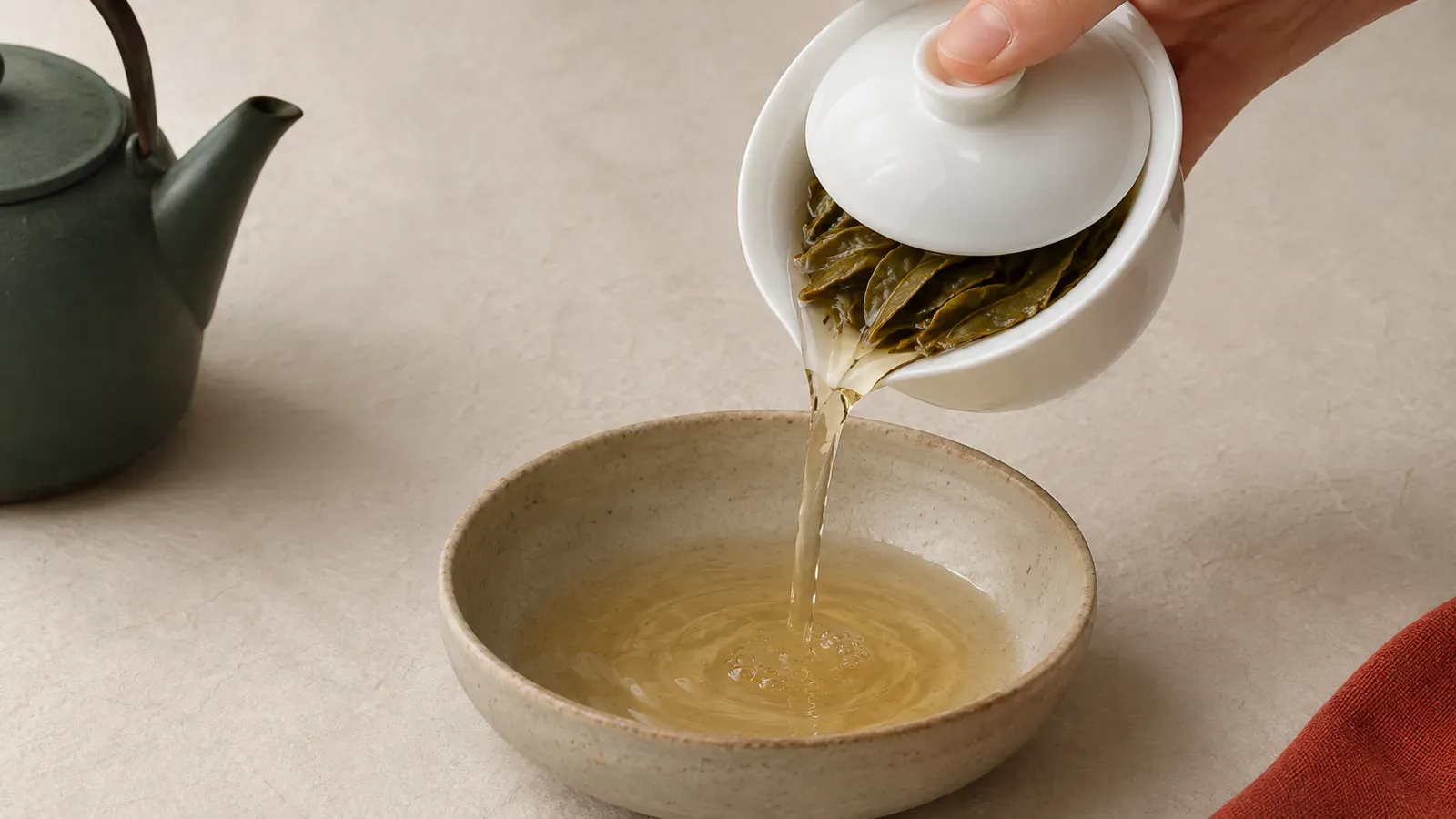
The rinse is the short first pour that you do not drink. Almost everyone who brews pu'er does it, but people give different reasons for it, and a few skip it. It helps to know what it does and what it does not do.
What is the rinse, and why does it have two names?
In Chinese the same step is called 洗茶 (xǐ chá, "washing the tea") or 醒茶 (xǐng chá, "waking the tea"). Some people prefer 润茶 (rùn chá, "moistening the tea"). The action is identical: hot water on, a short wait, water off. The names point to two different purposes, cleaning and opening.
One note on terms. 醒茶 is also used for something else: breaking up a cake and letting the pieces air in a jar for days or weeks before drinking. That is a storage habit, not the rinse described here.
What does the rinse actually do?
- It opens compressed leaf. A piece from a cake is dense, and water needs time to get inside. Without a rinse, the first cup is often pale and the second suddenly strong.
- It washes off dust and small fragments. Pressing, breaking and years of storage in paper all leave fine dust and broken leaf. Rinsing them away gives a clearer cup.
- It warms the leaf and the vessel. The next pour stays hot, which matters for a tea that needs heat.
- It lets you smell the tea. Lift the lid after the rinse. Cleanly stored tea smells of tea, wood or dried fruit. Sour, fishy or musty notes show up here first.
With young ripe pu'er, a rinse also takes away some of the fermentation smell, called 堆味 (duī wèi), that the tea carries in its first year or two.
A rinse does not turn badly stored tea into clean tea. If a tea still smells of mould after two rinses, the problem is the tea.
How long should you rinse, and how many times?
| Tea | Rinses | Time each | Water |
|---|---|---|---|
| Ripe pu'er, loose or lightly pressed | 1 | 5–10 seconds | 100°C / 212°F |
| Ripe pu'er with a strong fermentation smell | 2 | 5–10 seconds | 100°C / 212°F |
| Young raw pu'er | 1 | About 5 seconds | 90–95°C / 195–205°F |
| Aged raw or aged ripe (over 10 years) | 1–2 | 5–10 seconds | 100°C / 212°F |
| Very tight tea: iron cakes, tuocha, mini tuo | 2 | 10 seconds | As for its type |
These are common starting points, and experienced drinkers do not all agree. Two things hold in every case. Keep the rinse short, because a long rinse throws away tea you paid for. And pour all of the water off, so the leaf does not sit in a puddle and over-steep before the first real cup.
After rinsing a hard lump, put the lid back on and wait half a minute. The steam keeps loosening the leaf, and the first infusion comes out more even.
What water temperature should you use for the rinse?
Use the same water you are about to brew with. That means boiling water for ripe and aged pu'er, and slightly cooler water, roughly 90–95°C, for young raw pu'er. A lukewarm rinse does very little, because it neither opens the leaf nor warms the vessel.
Can you drink the rinse?
You can. Nothing about the rinse makes it undrinkable. It is thin, it carries whatever dust was on the leaf, and it does not taste like the cups that follow, so most people pour it away or use it to warm the cups.
Some drinkers taste the rinse of a clean, loose tea out of curiosity. Where a tea gets two rinses, the second one is often close to a light first cup.
When can you skip the rinse?
- Loose young raw pu'er from clean storage. The leaf is already open and the aroma is at its freshest in the first pour. Some drinkers skip the rinse, or make it a pour-on, pour-off "flash" rinse.
- Fine-cut pu'er in tea bags. Small particles give up their flavour very fast. A rinse takes much of it with it.
- Leaf you already rinsed earlier the same day. It is open. Carry on from where you stopped.
Do not skip it for ripe pu'er, aged pu'er or anything tightly compressed. Those are the teas where the rinse makes the clearest difference.
What are the common rinsing mistakes?
- Rinsing too long. Thirty seconds is an infusion, not a rinse.
- Leaving water in the bottom. Tip the vessel fully and give it a second to drain.
- Using water that has cooled. Reboil the kettle first.
- Rinsing again and again to remove a smell. One or two rinses lift surface dust. They cannot fix a storage fault.
- Stabbing the cake into crumbs beforehand. Broken leaf brews fast and harsh, and no rinse corrects that.