 Chama Cellar
Water makes up nearly all of the cup, and the vessel decides how hot the leaf stays and how fast you can get the tea off it. Neither has to be expensive. A few choices matter a lot, and most of the rest is preference.
What kind of water is best for pu'er?
Soft water with a low mineral content and no smell of its own. In practice that usually means one of these:
- Filtered tap water, where the local supply is soft to moderately hard.
- Low-mineral bottled water. The label normally gives a figure for dry residue or total dissolved solids. Lower numbers mean softer water. Many tea drinkers look for something under roughly 150 mg/L, but there is no agreed figure.
- Clean, soft tap water straight from the cold tap, if that is what you have.
Very hard water is the one to avoid. It tends to make the tea darker, cloudier and flatter in taste, and a thin film often forms on the surface as the cup cools. If your kettle furs up quickly, your water is hard.
At the other end, distilled and reverse-osmosis water have almost nothing dissolved in them. Many drinkers find tea made with them thin or flat, although some people use them happily, so this one is a matter of taste.
The simplest test is to brew the same tea twice, side by side, with two different waters. The difference is usually easy to taste, and your own preference is the answer.
Is tap water good enough?
Often, yes. It depends on where you live.
- If it smells of chlorine, a carbon filter jug removes most of the smell.
- If it is hard, a jug filter that also softens the water helps somewhat. Where the water is very hard, a low-mineral bottled water makes a clearer difference.
- Always fill the kettle from the cold tap. Water from a hot tap or an office dispenser is not hot enough and often tastes stale.
How hot should the water be?
| Tea | Water |
|---|---|
| Ripe pu'er | 100°C / 212°F |
| Aged raw pu'er (over 10 years) | 100°C / 212°F |
| Mid-aged raw pu'er (3–10 years) | 95–100°C / 205–212°F |
| Young raw pu'er (1–3 years) | 90–95°C / 195–205°F |
| Tender, bud-heavy raw pu'er | 85–90°C / 185–195°F |
Ripe and aged pu'er need a full boil and go flat when the water cools, so reboil the kettle every few rounds. Young raw pu'er turns bitter more easily and is better slightly cooler. Without a thermometer, leave the kettle open for one to two minutes after it boils and the water drops to roughly 90–95°C. The differences between the two types are explained in ripe vs raw pu'er.
Which vessel should you brew in?
| Vessel | What it does to the cup | Leaf and time | Who it suits |
|---|---|---|---|
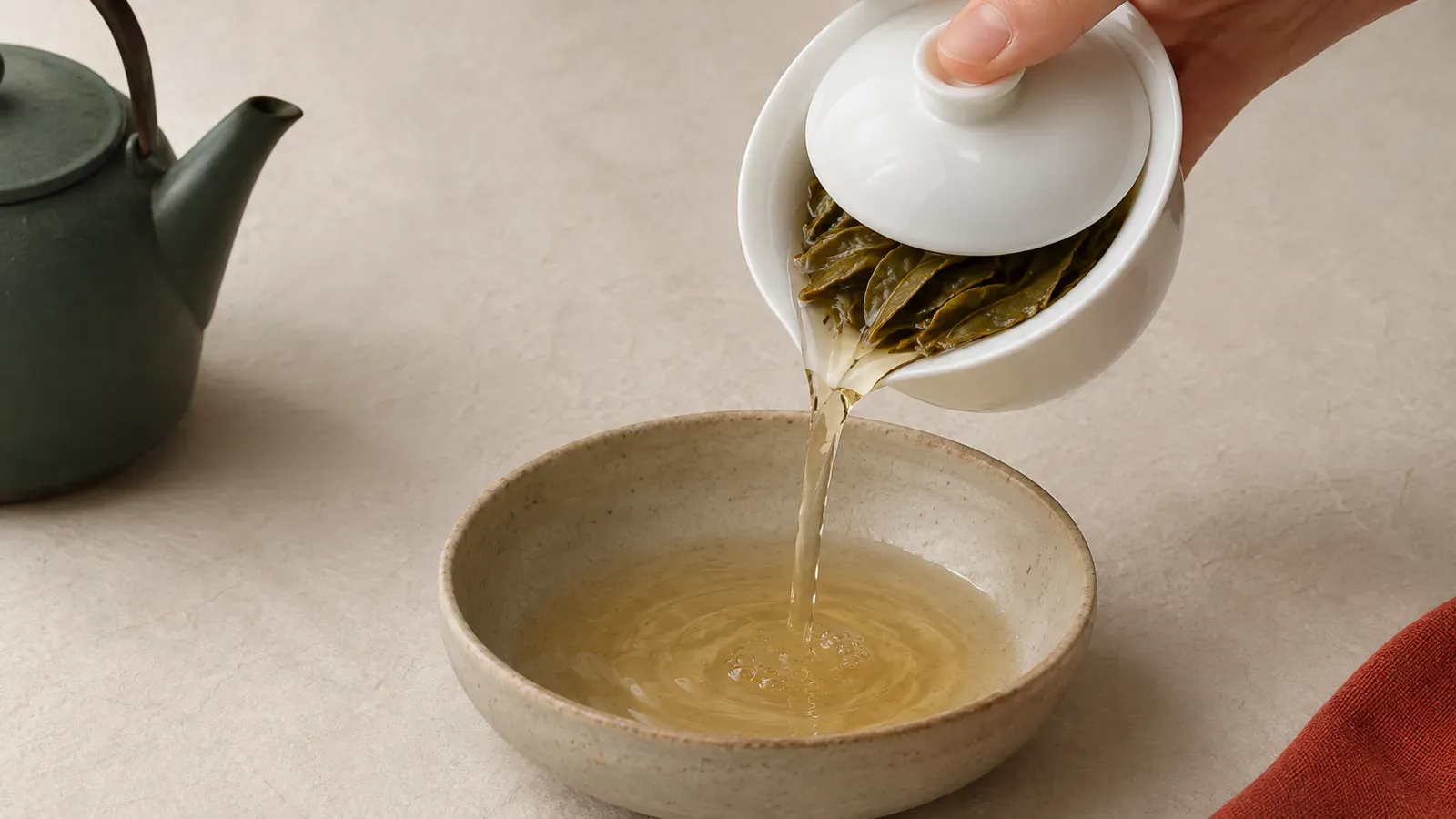
| Porcelain gaiwan, 100–120 ml | Neutral. Shows the aroma, and any faults, clearly. Pours fast, so short steeps are easy | 5–7 g, many steeps of 10 seconds and up | Anyone learning, anyone comparing teas, and drinkers of young raw pu'er |
| Yixing clay (zisha) pot, unglazed | Holds heat well. Many drinkers find the cup rounder and softer, with the highest aromas slightly muted | About 1 g per 15–20 ml, short steeps | Regular drinkers of ripe or aged pu'er who will keep the pot for one type |
| Glass or porcelain teapot, 300–500 ml | Neutral. Longer steeps give a fuller cup with less detail from round to round | About 5 g per 400 ml, 3–4 minutes | Sharing at a table, drinking with a meal, ripe pu'er |
| Mug with an infuser basket | Neutral and simple. The least control, but a perfectly good cup | About 3 g per 300 ml, 3 minutes | A desk, a first try, ripe pu'er |
The first two are for gongfu brewing, with a lot of leaf and many short steeps. The step-by-step method is in how to brew pu'er gongfu style. The last two are everyday methods, covered in how to brew pu'er without a gaiwan.
Glazed porcelain and glass do not take on flavour, so one gaiwan or one glass pot can serve every tea you own. That is the main practical difference from unglazed clay.
Why do people keep one clay pot for one type of tea?
Yixing zisha (紫砂, "purple sand") is an unglazed stoneware from Yixing in Jiangsu province. The fired clay is slightly porous. With use, the inside of the pot takes on some of the aroma of the tea brewed in it, and tea drinkers call a pot that has been used for a long time "seasoned".
That is why a clay pot is normally given one job. A pot that has brewed ripe pu'er for a year carries an earthy note that does not belong in a young raw pu'er or an oolong. Most people settle on one pot for ripe, another for raw, or simply one pot for the tea they drink most.
For the same reason, an unglazed pot is never washed with detergent. Rinse it with hot water after use, tip out the leaves, and leave it to dry with the lid off.
Yunnan has its own unglazed pottery, from Jianshui (建水紫陶), which is also widely used for pu'er. The same one-pot-one-tea habit applies to it.
Does a clay pot make better tea than a gaiwan?
It makes different tea. A thick-walled clay pot keeps the water hotter for longer, which suits ripe and aged pu'er. How much the clay itself changes the taste varies from pot to pot, and drinkers disagree about how large the effect is.
Two cautions for beginners. A clay pot pours more slowly than a gaiwan, so every steep runs a few seconds longer than you counted. And a great deal of what is sold as Yixing clay is not, which is hard for a newcomer to judge. Learn on a gaiwan first. You will then know what the tea tastes like on its own, and you can tell what a pot adds.
What does a beginner actually need?
For a mug of pu'er: the tea, a kettle, and a mug with an infuser basket. Nothing else.
For gongfu brewing, add:
- A porcelain gaiwan of 100–120 ml. Plain white shows the colour of the liquor.
- Something to pour into. A glass pitcher is the usual choice, but any small jug or a second mug does the job.
- A small cup or two.
- A kitchen scale that reads to one gram. Compressed tea is hard to judge by eye.
- A bowl for the rinse and waste water.
A tea tray, a strainer, tongs and a tea pet are optional. They keep the table tidy and do not change the tea.
What kind of kettle do you need?
Any kettle that brings water to a real boil. Three features are useful, and none is essential:
- Temperature settings. Handy for young raw pu'er, although letting boiled water stand for a minute does the same thing.
- A narrow spout. It gives a slow, aimed pour, which helps when filling a small gaiwan.
- A keep-warm base, or a kettle small enough to reboil quickly. A session lasts many rounds and the water must stay hot.
Descale the kettle now and then if your water is hard. Loose scale ends up in the cup and dulls the tea.