 Chama Cellar
The answer depends on one number: how many grams you put in the pot each time. Everything else is division. The figures below use the same doses as the brewing guides on this site, and each assumption is stated so you can swap in your own.
How many grams go into one session?
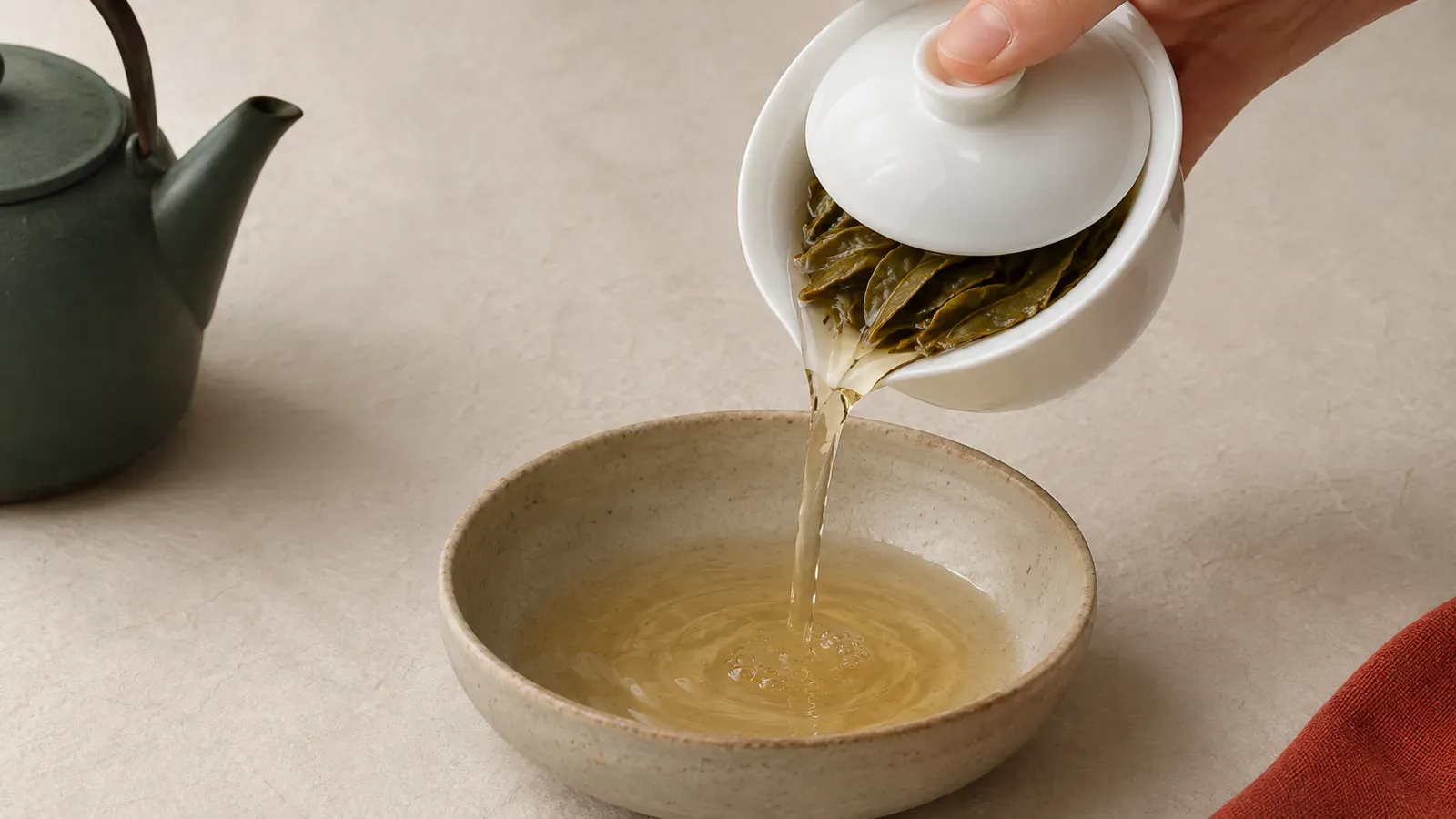
- Gongfu brewing: about 5–8 g. The usual ratio is 1 gram of leaf per 15–20 ml of water, which is 5–7 g in a 100–120 ml gaiwan. People with a larger gaiwan, or a taste for strong tea, use up to 8 g. See how to brew pu'er gongfu style.
- Mug or teapot: about 3–5 g. That is 3 g for a 300 ml mug and 5 g for a 400 ml teapot. See brewing pu'er without a gaiwan.
A kitchen scale helps here. A piece of compressed tea is heavier than it looks, and guessing by eye usually means using more than you think.
How many sessions does a 357 g cake give?
Divide the weight of the cake by the dose.
- Gongfu, strong: 357 ÷ 8 = 44.6
- Gongfu, light: 357 ÷ 5 = 71.4
- Teapot: 357 ÷ 5 = 71.4
- Mug: 357 ÷ 3 = 119
So a cake is roughly 45 to 70 gongfu sessions, or 70 to 120 mug or teapot brews. A middle dose of 6 g gives 357 ÷ 6 = 59.5, about 60 sessions.
How much tea is that in cups and litres?
Gongfu. The same leaf usually gives eight to twelve infusions. A 100–120 ml gaiwan is not filled to the brim and the wet leaf takes up room, so assume about 80–100 ml comes out per pour.
- Low end: 8 × 80 ml = 640 ml
- High end: 12 × 100 ml = 1,200 ml
That is somewhere between two-thirds of a litre and a little over a litre per session. Taking 900 ml as the middle, and 40 ml as a typical small cup, one session is about 22 small cups, and 60 sessions is 60 × 0.9 = 54 litres. Call it about 50 litres per cake, or well over a thousand small cups.
Mug. At 3 g per 300 ml mug, a cake fills 119 mugs on the first steep alone. Pu'er in a mug can usually be re-steeped twice, with a longer time each round. Count those and the same 3 g gives three mugs: 119 × 3 = 357 mugs, about one mug per gram of tea. The later mugs are lighter than the first.
These are upper estimates for good leaf brewed to the end. Broken leaf gives fewer rounds, and some aged teas give more.
How do 100 g, 200 g, 250 g and 357 g formats compare?
The same division for the common cake, tuo and brick sizes, rounded down:
| Format | Gongfu sessions (5–8 g) | Mug or teapot brews (3–5 g) |
|---|---|---|
| 100 g | 12–20 | 20–33 |
| 200 g | 25–40 | 40–66 |
| 250 g | 31–50 | 50–83 |
| 357 g | 44–71 | 71–119 |
In each cell the lower number is the heavier dose. A seven-cake tong of 357 g cakes is about 2.5 kg, or seven times the bottom row: roughly 310 to 500 gongfu sessions.
How long does a cake last at one session a day?
At one session a day, the number of sessions is the number of days.
- Gongfu, 5–8 g a day: 44–71 days, about six to ten weeks.
- Mug or teapot, 3–5 g a day: 71–119 days, about ten to seventeen weeks.
Three sessions a week stretches a cake to somewhere between three and six months for gongfu. Sharing a session does not change the sum. Two people at one gaiwan use the same leaf as one person, they just each drink half.
Most people do not drink the same tea every day, so in practice a cake lasts much longer than this. That is rarely a problem: stored properly, pu'er keeps for years.
How much is lost as dust and crumbs when you break a cake?
There is no fixed figure. It depends on how tightly the cake was pressed, on the tool, and on patience. A loosely stone-pressed cake comes apart in layers with little waste. An iron cake or a tight tuo sheds far more.
As a working assumption, take 3–5 % of the cake as dust and small fragments:
- 357 × 0.03 = about 11 g
- 357 × 0.05 = about 18 g
That is one to three sessions. With a 5 % allowance the cake is 339 g of whole leaf, or 42 to 67 gongfu sessions in place of 44 to 71.
The crumbs are not waste. They are the same tea, but they brew fast and strong. Keep them in a jar and use them in a mug with an infuser, with a shorter steep, or mix a pinch into a session of whole leaf. Only the finest dust, which clouds the cup, is worth throwing out.
To lose less, slide a tea pick or blunt knife into the edge of the cake and lever off flakes along the layers. Do not stab downwards. Work over the open wrapper so the fragments are caught.
What assumptions are these numbers based on?
- The cake weighs 357 g. That is the nominal weight. A real cake can be a few grams over or under, and it changes slightly with the moisture it holds.
- You weigh the leaf. Without a scale, doses drift upwards and the cake goes faster.
- Eight to twelve gongfu infusions. This is a typical range for whole leaf, not a promise for every tea.
- Two re-steeps in a mug. Fewer if you like every mug strong.
- A 3–5 % allowance for crumbs. This is an estimate, not a measured standard.
If you are deciding what pu'er to buy first, the practical point is that a full cake is a lot of tea. A sample or a 100 g format is enough to find out whether you like something.